END DIETRICH FARR
CHILDREN
TRAVEL GALLERY
Who is Richard Farr Dietrich?
Or,
Whatever Happened to That Cute Kid and Handsome Dog?


1939?
1957
(at 21) Now!
Well, I dunno, I've checked with the usual suspects--nature and
nurture, heredity and environment--who are supposed to be the responsible parties
in these matters of identity, but it's hard to credit the story they've come up
with. And it all seems so
superficial. Anyway, here it is, and
never mind that it reveals a certain addiction to slinging the bull on the
narrator's part:
YOUR HUMBLE NARRATOR
(In a bullring in Ronde, Spain)

First of
all, no bull about it, I am a late edition of a certain gene pool. Does that matter? Maybe, maybe not. Many Americans are on a genealogical quest
for ancestors these days because they feel that they'll answer the question of
who they are by finding out who their ancestors were. There may be something to that, although not
in the way most think. Finding
"blue blood" in the gene pool, for example, probably tells you
nothing about who you are, but finding Tourette's Syndrome might. Take, for example, the evidence
of the following photo, suggesting that I was destined for a throne.
Alas, it never panned out, depending upon what "throne" you're
talking about.
|
QUEEN
DOLLY & Richard II & THEIR COURT (Latin Club, PCHS. Circa 1950) |
|
|

Whatever, I
have found investigating my family tree most worthwhile (and this
tells you something about who I am) because it fulfills the hope
that I am at least descended from interesting people, some of whom are
interesting because of the way they tried to avoid being
interesting. Like my boringly virtuous
parents. I found in the family tree the
outlaws and victims of catastrophe I was hoping to find, for such notoriety is
crucial to a narrative such as this, but the boringly "straight"
relatives were just as fascinating because their virtue seems to have been
hiding something.
So let's
begin this autobiography by climbing around that family tree and checking out
the monkeys, starting with me and working our way down and back in time limb by
limb.
I was born,
not quite ready for the New Age, on the cusp of Aquarius, January 16, 1936, in
a Sandusky, Ohio hospital, there being no hospital at the time in Port Clinton, the town to the northwest across Sandusky
Bay where my parents were living. I may not have been quite ready for the
Age of Aquarius, but I was born ready to roll:

It took me a while to get out of Port
Clinton, however, which wasn't all bad because there was
lots to see and do there and most kids would be lucky to have such a
place to grow up in. Port Clinton was then a town of about 3,000 souls
between Toledo and Cleveland on Lake Erie and known as the "Gateway to the Islands," referring to Put-in-Bay (also called "South Bass") and about a
dozen other islands reachable by ferry or other boats from Port Clinton.
Yesterday’s Port Clinton looks like this from the air:
The “PCHS” refers to my high
school, now demolished!


And above is what my neck of the woods, essentially
a peninsula, looked like in the old days.
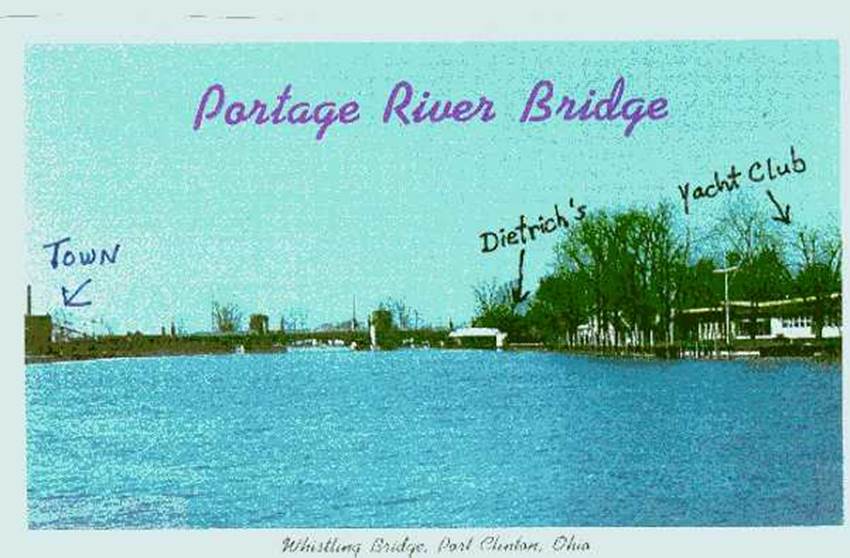
Below is the bridge that sang with traffic (calling it “Whistling
Bridge” doesn’t quite get it)
and was
always a sight to see when it went up to let some tall yacht or sail boat go
through.
The Bridge Tender was my buddy, as I walked over it every day to and
from school.
Below is what the downtown looked like, south from the
river, in the 1950s, my heyday.
Look for a '49 black Pontiac, or a '53 green Pontiac, or
an orange and white '56 Hudson Wasp,
the cars I drove in that decade of miraculous but
clueless youth.

Was it
always summer in Port Clinton? Only when I want to remember the place
fondly. All too often it froze my bones. To make the picture a
little more complete, then, the following photos (scenes around our house)
remind me of one of the principal reasons I left Beautiful Ohio and settled in
Florida:
Below, the front of our house & our neighbors to
the right. The sidewalk from
our back porch to our dock & boat
house, with the garage and Dad’s shop to the
right.
Above, the view from Mrs. Kelly’s
house, A view of the Log Cabins across the street and on Lake Erie.
to
the east and next to the Yacht Club.
But let's remember it as summertime,
shall we?
In addition
to all its natural attractions, with water water
everywhere, Port Clinton and its environs has a bit of national history (and national typology) behind
it, at least one item of which has something to say about who I am. First, let's review the items that didn't
directly touch me but mattered in the sense that they helped define the community
I grew up in.
Port
Clinton was named after that far-seeing master of city and country planning,
New York Governor DeWitt Clinton (1769-1828),
who, after seeing (politically) to the gridding of Manhattan and the building
of the Erie Canal, had plans to build a canal, connecting several rivers, from
Port Clinton to the Ohio River, which he thought would open up the interior of
the country to boat trade (But the railroads eventually took care of the trade,
Clinton not being quite far-seeing enough).
Perhaps in anticipation of becoming a canal gateway, Port Clinton began
as a major boat-building center. [One of my best friends as a kid, by the
way, was Scot Reynolds, the son of the manager of Matthews' Boat Works, and he
never ceased trashing Chris Crafts, their major rival in yachts. Scot is
the one on the left below (1948), getting the credit from the mayor, but I'm
the one on the right who actually sold the cat-tails (a claim Scot can't defend
himself against, having passed on to that great scout camp in the sky).
I'm not quite sure of the logic of this cat-tail drive, but apparently it was
my maiden voyage as an environmentalist. Those lake front cat-tails have since mostly been bulldozed or buried under
“land reclamation”]:

Among other
items of national interest, just east of Port Clinton, there was a Confederate cemetery (formerly a prison) on
Johnson's Island, in Sandusky Bay just off and south of the Marblehead
Peninsula, and Lakeside, on the north
side of the Marblehead Peninsula, a major Chautauqua center for many years
visited by the rich and famous and pious. And, closer to Port Clinton and to
the northeast, was Catawba Island (not
really an island but a peninsula after fill connected it to the mainland) which
had some renown for its vacation motels and trailer
parks on the thin beaches on its west side and its vineyards and orchards, now
mostly vanished, in the center. In my
teen years I spent many a cold Saturday in the winter trimming the apple trees
of great old guy and state representative Bill Rofkar,
the uncle of my good buddy Bart Drickhamer, who,
along with Bill's son John, later a school principal, made up the work
crew. From this crew I must have learned some storytelling and how to
tell bawdy jokes. Laughing hard enough to fall out of trees is how we
kept warm and interested (so to speak).
These
orchards were part of a rich farming community around Port Clinton on all sides
in my youth that made Sunday drives enjoyable episodes of fruit-picking,
corn-harvesting, and the like, and fun drives with girls as well. The cider
available in the fall was real cider, that after a week or two of
sitting on the back porch took on the kick of a mule. I would kill for such
cider today.
However,
from my perspective as a teenager, Catawba Island’s most important feature was
a Drive-In Movie Theater, known as “the passion pit” by guys and gals
alike. That was, alas, just before “the
sexual revolution” of the 60s, but, with Elvis Presley as our King, we tried
to lead the way.
Other
features on Catawba Island, with national resonances, were a golf course where
I caddied and learned to play golf, an area just above that and around the
northwestern bend known as “The Cliffs,” where the 1% lived in very nice
houses, rock houses being the most spectacular, from which they had a very
close view of Put-in-Bay, quickly reached by ferry at
the tip of Catawba, and around and below the northeastern bend was “Gem Beach,”
containing a roller skating rink, a penny arcade full of the sort of games that
preceded Pac Man and other eGames, and, the real gem,
a dance hall and bar, about half of which had clear, starlit sky above, made
for romantic dancing. This was one of
those places where rock ‘n roll was invented, though I preferred slow dancing cheek
to cheek.
One update interjected here, to prepare for some
irony to follow. I don’t know exactly
when this happened, but these days you can see clearly, from almost everywhere
on the Port Clinton and Catawba Island lake front, a profane nuclear reactor
looming menacingly a few miles west. And
a study of a detailed map shows a huge NASA plant just below Sandusky and about
the same size as Sandusky, something I didn’t know existed until quite
recently. So the PC area is ready for
the future, so to speak, as explosive as it may be. Now let’s go back to the features of the area
that pertain to my time there and that are of national interest or typology, to
draw a contrast between past and present that speaks to how fast the world
changes.
Just a few
miles off the northern top of Catawba Island, on the first island north of PC,
there is a monument to a national celebrity who affected me personally, Commodore Perry, who of course in the War of 1812
defeated the British in the Battle of Lake Erie and whose heroics--"We
have met the enemy and they are ours"--called for the later construction
of Perry's Monument on Put-in-Bay.
The inviting presence of this memorial occasioned many thrilling trips in my
youth over the water on ferry boats or my Dad’s boat to climb our country's
second tallest monument and to experience defining moments. That island was often visible from the lake
front just across from our house.

A
"defining moment" certainly arrived the first time I climbed Perry's
Monument. Unfortunately, these "climbs" (i.e. elevator rides to the
top of Perry's Monument) revealed that I suffered from somewhat
less-than-heroic vertigo the minute I moved from the elevator to the
observation platform at the top. This vertigo
constituted one of my principal introductions to the discrepancy between the
world as I wished it to be (something I could comfortably look down upon from
angelic heights) and the world as it was (dizzying whenever one tried to
elevate). And since no one else in my
family seemed to suffer from vertigo, it brought home the fact that one can be
peculiar even among one's near clones.
Gene pools are as likely to spawn difference as similarity.
Had I been
able to stand up on Perry's Monument (I usually fell to my trembling knees soon
after getting off the elevator at the top or plastered myself against the wall
furthest from the edge), I might have seen the ghosts of speed boats past
darting here and there among the islands and, on a clear day, sensible Canada
lining the northern horizon. For those islands in mid-lake also served as
transfer stations for bootleggers from
Port Clinton and Sandusky meeting entrepreneurs from Canada during the madness
that was Prohibition. I like to imagine that my evening bourbon is somehow
spiritually connected to this derring do. [Update: Cancel the bourbon, as Peripheral
Neuropathy in legs and feet has recently reduced my
alcohol intake to moderate amounts of wine and beer. How did this
happen? I was counting on being an old drunk and now I find myself “a
moderate drinker.” Oh, Pshaw! ![sad-face-psd78749[1]](bio2015_files/image029.gif) ]
]
Exciting
stuff, that bootlegging, but my boringly virtuous parents had little to do with
that beyond perhaps purchasing an illicit fifth of bathtub gin from time to
time and, after Prohibition was repealed, sharing the ownership of one of
those used, varnished speed boats for a while.
Gas-guzzlers at top speed!!
It took
some digging and some serendipity to get to the reasons for my parents'
virtuous but boring lives. Here are my virtuous parents, Marion and Dick
Sr., and their virtuous son and daughter, Dick Jr. and Marilyn. I am now taller than my very tall sister was
then:
TOP
The Dietrichs of
Port Clinton, Ohio

My
parents were Marion Margaret Farr
Dietrich (raised as a farm girl in Danbury, Ohio) and Richard Franklin Dietrich (born in Milan, Ohio,
south of Sandusky, but raised mostly in Gypsum, Ohio, on Sandusky Bay, site of
large gypsum mines and factories where plaster and wall board were made, the
Celotex loading docks providing my summer paycheck to help pay for 5 years of
college). Danbury and Gypsum are just to
the east of Port Clinton and divided by Route 2, the road that leads on a
bridge over Sandusky Bay to Sandusky and Cleveland. That two-laned bridge,
on the way to movie dates in Sandusky, was the scene of many suicidal moves in
my early driving days, which I’ve lived to tell. My date often said she was gonna kill me if I kept up those brushes with death, so how
could I not lose. Scare the girls was always the point.
Map of the Port
Clinton area,
with the Bridge of Terror in the middle:

Zoomed in
and including Cedar Point:

Zooming Out:
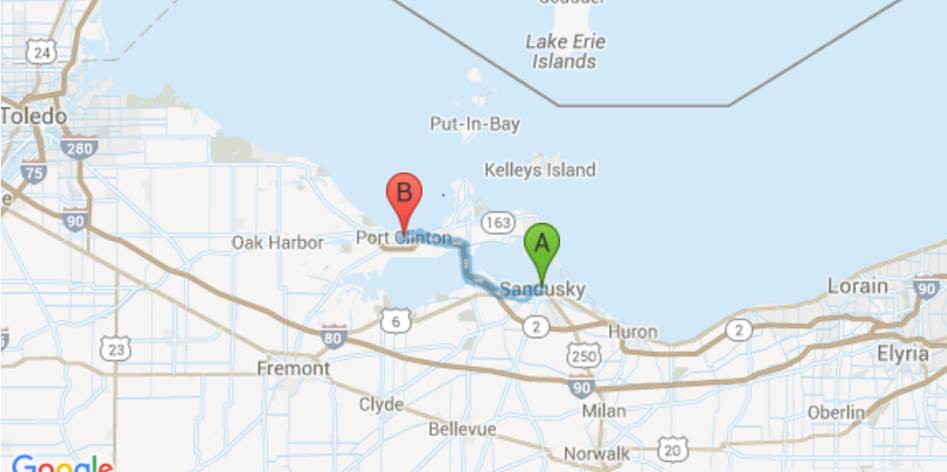
See http://www.distancebetweencities.net/sandusky_oh_and_port-clinton_oh/route
The fact that
my father was born in Milan, Ohio (below Sandusky), the same town Thomas Alva
Edison was, illustrates how lightning can strike the gene pool right next to
yours, so to speak, leaving you to wonder why yours missed all the excitement. My father, whenever he fooled with the
electrical stuff around the house, was teased as “Edison.” But he was actually very good at it, as at
everything “handy.”
Perhaps the
location in this area that is most famous, as far as general recognition is
concerned, is Cedar Point, where fun-seekers went for the thrill rides on the
infamous roller coasters, and still do.
Well, never
mind geographical location, where had boring Richard and Marion come from,
gene-pool-wise?
From not-so-boring ancestors, it
turns out.
First,
Dad’s family--the Dietrichs and the Fabians.
My father's
great-grandparents, John & Minnie Dietrich,
apparently emigrated from Lower Saxony in northern
Germany, in the area of Mecklenburg County and the resort city of
Schwerin, in the 1850s. In America, one of their sons, Frederick Joseph Dietrich, married Hannah Roose in 1869, the Rooses
being huge landholders in the Oak Harbor and Port Clinton area, once owning, so
I was told, the land on which the Yacht Club, the Log Cabins, and our house
stood (about which more anon). They had 12 children, one of whom was to become
(ta da):
The notorious Ernest
Dietrich, my grandfather.
See below a portrait
of the reprobate as a young man:

Frederick & Hannah with family, circa 1894
It was marriage that made Ernest
Dietrich notorious, thanks partly perhaps to the woman he married, my
grandmother Emma
Amanda Fabian, in 1895.
First, a
bit about the Fabians (no relation to The Fabian Society in
England, alas). I vaguely
remember a story that the Fabians had emigrated from a part of
East Prussia given to Poland after WWI (thus the presence of Polish names, Wargowski and Sperlinksi, in our
family tree) in order to assist a certain "Uncle
Otto" to escape military service during the Franco-Prussian
War. I enjoy the possibility of being
related to such a sensible person, and I thank all my relatives
for getting the hell out of militaristic Germany. The only males in my family who ever served
in the military came in by marriage, and there weren't many of those. My
Uncle Elmer was in the Battle of the Bulge, and that was about it. Here's our draft-dodging model, Uncle Otto
Fabian:

Whether the
story about the draft-dodging "Uncle Otto" is true or not, Otto's
sister, Emma, certainly earns her stripes in this story by showing us the
importance of being Ernest. Ernest and Emma Dietrich, apparently living in
first Milan, then Enterprise, and then Gypsum, Ohio, had five children, known to me as Uncles Rollie and Fred, Aunts Minn and
Jo, and my father Dick Sr. (born in 1908), the baby of the lot. Now in the (circa
1910) picture below, things don't look so bad. If nobody's smiling here, it's because no
photographer ever said "cheese" in those days. They thought a sober face revealed the soul,
whereas smiles are false. Little did
they know.
Below is my
Dad’s family before he was born (1906?), so only 4 kids to this point, my
uncles and aunts.
The house looks like the house in
Gypsum across from the railroad station from which local fruit was shipped:

And then, below, the full family (except for an esoteric branch,
perhaps not known to anyone but Ernest at this time):

Quite a
brood. But the problem was
that the Fab Five depicted above weren't all the children ol' Ernest had. It
seems Ernest had a second family in Sandusky, and
he may have attempted a third in Toledo!!
When Emma found out about this (1922?), all hell broke loose,
and ol' Ernest went to
jail for bigamy and forgery (apparently more than
once, after she bailed him out the first time and he failed to follow through
on his repentance). This taking on of two families is the only
instance of heroic behavior in the Dietrich side of the family known to me!
What must
Emma have been like to drive Ernest to such importance? Or was he the "cur" and "base
coward" the newspapers said he was?
One wonders what the happy family below knew about Ernest in 1912, just
before he went bananas and married the second woman (giving me unknown
relatives!):

Dietrich Family Reunion, 1912
Well, I'm
real sorry I missed that party, aren't you?
Imagine how much more sour the expressions on the faces would have been,
especially Emma's, if they had known that just a few months hence Ernest would
run off to Detroit to marry the woman from Sandusky, two days after
promising a judge he would do better to support his and Emma's five kids!! Although he and Emma were still officially
married, apparently she had to haul him into court to support the family. Sounds like an absentee father. What's missing here is any mention of the
possibility that Ernest had for some time devoutly wished for divorce but was
prevented from it by circumstances.
Divorces were not as easy to come by in those days. Could it be that he lived on and off with two
families for nine years because he couldn't figure a way out of that?
Whatever,
let's at least consider the possibility that Emma was not blameless. A clue to Emma's character may arise from the
way Emma treated at least one of her children.
Because during the nine years between 1913 and the 1922 (?) divorce, when Ernest seems to have
been absent much of the time, and three of the children were still young (Dick
was 5 in 1913), justifying Emma's staying home, her two older sons were forced
to support their mother and the family.
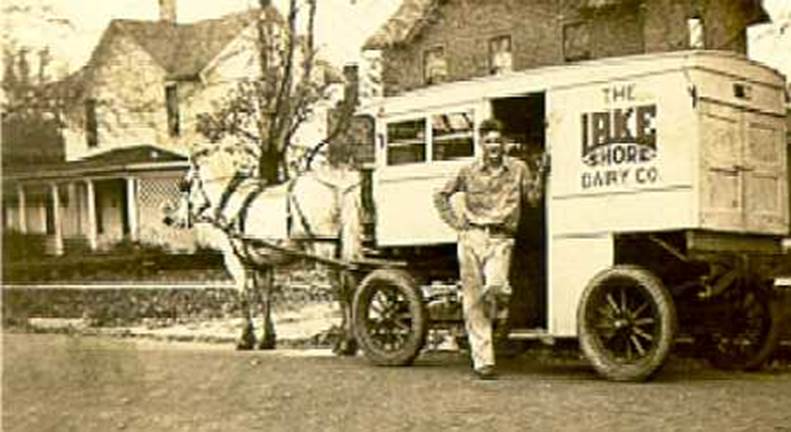
Here's Uncle Fred, for example,
working his milk route in Port Clinton over brick-paved streets:
But the
older Rollie and Fred were able to at least complete
high school, whereas Dick, despite being
a very promising student, was forced to quit school
after the ninth grade (when he was 16)
and go to work. Dick was not grateful to his mother for this. The (circa
1920) picture below suggests a boy wanly enjoying what little is left of his
boyhood:

Did Dick know that his days as Tom Sawyer were numbered?
Dick
Sr., as I came to know my father, all too soon after this
picture was taken, at the age of 16 (1924) became the manager of Kroger grocery stores
in Oak Harbor (upriver to the west of Port Clinton) and Perrysburg (near
Toledo), but most of his long career of managing Kroger stores occurred in Port
Clinton. In those days you were considered manager material if you could
read and write and do arithmetic, and of course do them well. Here's Dad, on the right in both pictures,
first as the manager of the Perrysburg store and then of the Oak Harbor store.


After
quitting Kroger's in the early 1950s when his lack of formal education blocked
him from being promoted and he found running the town's new Kroger supermarket
too aggravating, he managed Sorenson's old-fashioned Grocery Store for a few
years (where I worked summers and Saturdays as a teen-ager), and he had brief
stints as an all-purpose construction worker and a salesman of Pontiacs and
Cadillacs. Eventually he settled into
his final job of credit manager at Magruder Hospital. He was offered the job of the hospital's
director when he decided to retire instead (1970), after a lifetime of being
one of Port Clinton's most respectable and respected family men and a pillar of
the community. Unlike Ernest, his
apparently ne'er-do-well father, Dick Sr. spent a long lifetime working to
support a family. You could say he spent his life trying to live down his
father's ill repute. And that's why my
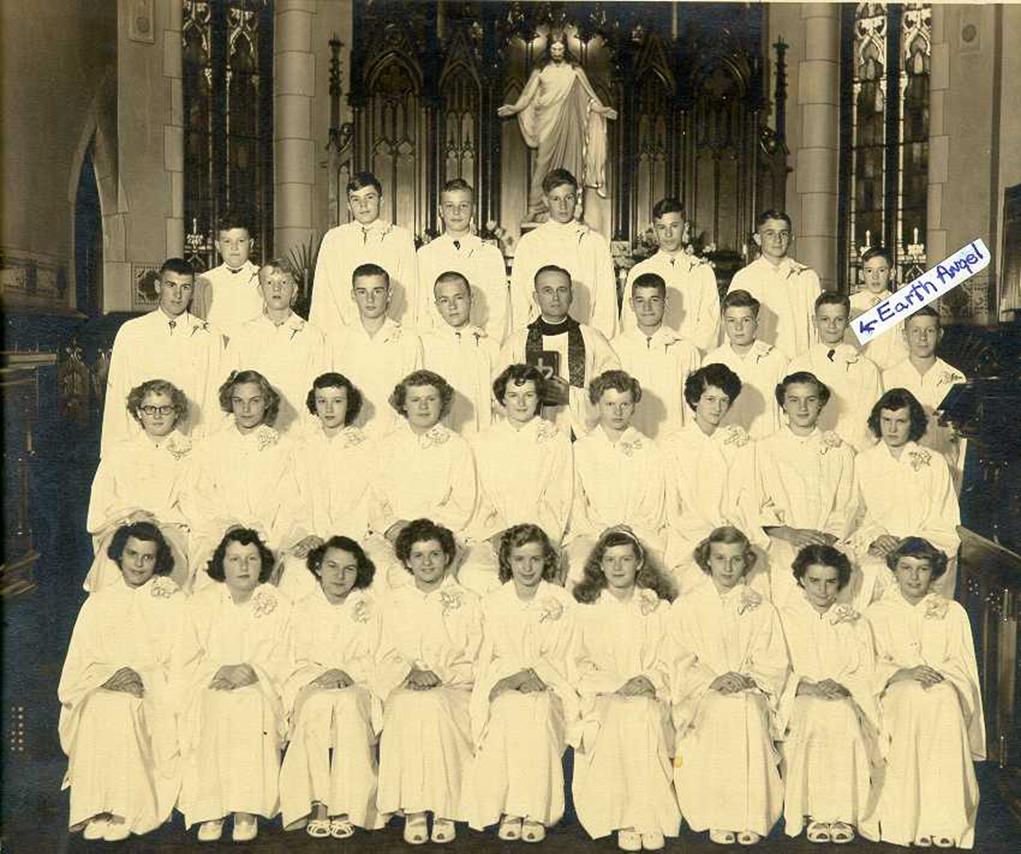
parents were so boringly virtuous, and Dick Jr. was expected to be so too. And that's undoubtedly why, while my parents
went fishing on Sunday mornings, I was sent to represent them at church, where
I racked up 10 years of perfect Sunday School attendance!! That devil Ernest forced us to be angels! Ironically, I can't stand piety or its
pretense anymore, but here I am being confirmed in it:
It's
significant that I knew almost nothing of this dark side of the family history
growing up, although I always wondered why there seemed to be resentment about
the monthly check my father sent to contribute to my grandmother's nursing home
upkeep. The much-abused Emma lived to be
99, by the way, which gave that resentment ample time to build up and
occasionally boil over. Although
longevity must have been in the genes, because Emma's brother and a first
cousin topped 100, there were grumblings among her children that it was mainly
bile against her bigamist but long dead ex-husband that kept her alive.
What I
mostly remember about my grandmother is
not that she was "a woman wronged" (that I didn’t understand
until much later) but that she provided the fantastically delicious home-grown
tomatoes, home-baked bread, and home-churned butter I was treated to on visits
to her Gypsum home when I was quite young. Also where I was introduced to
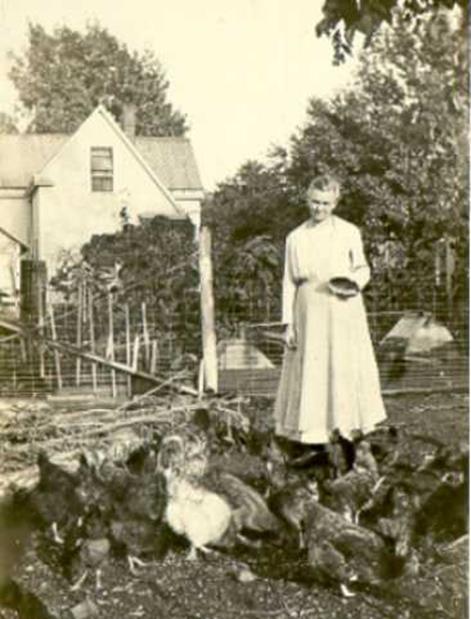
an actual “outhouse,” the only one I’ve ever used. Here's the grandma I remember, feeding her
chickens after feeding me scrumptious tomato sandwiches lathered with
mayonnaise:
Later, on
her obligatory Christmas or Thanksgiving visits to our house on River Front in
Port Clinton, I recall her as a rather shapeless, burping old lady, always
complaining. But it appears she had a
talent for writing, maybe even bore a life-long frustration at being unable to
fulfill it, and so it's fair to consider the possibility that being saddled
with five kids while Ernest cavorted about might have done this potential New
Woman in.
At any
rate, once, near the end of her life, she sent me perhaps the only letter she
ever wrote to me, which did indeed reveal both her talent and her frustration,
but which principally revealed her life-long grievance, for it came with 1922 (?) newspaper clippings denouncing Ernest Dietrich as a
cad for practicing bigamy and forgery and pronouncing him well deserving of
jail. I knew why she had
written. She wanted vindication from me,
that's what. She had heard that I was a writer of sorts, and she hoped I would
someday tell her story. Here it is,
grandma, though I'm sorry I never met my grandfather Ernest or got to hear his
side of it. Although he probably would
have just told a tall tale similar to the ones he is reported telling various
women and various judges. Speaking of
those judges who sentenced Ernest, the one in Sandusky was also
named "Dietrich!" Hmmm, this
plot might be thicker than even I am capable of imagining.
A side note: About a year
or more before the Berlin Wall came down, Lori and I decided to take a trip
into East Germany to see if any remains of the Dietrichs could be found, in
records or on tombstones, since my Uncle Rollie told
me that the few remaining had been wiped out by the Russians. With a special visa for a 24 hour stay, we
crossed the border and drove through picturesque country (harvesters with
scythes to be seen, like an old painting) and eventually Schwerin, an
attractive if old and crumbling resort town on a lake. The town cemetery’s tombstones had so worn
down that they were unreadable, and a stop at a tourist bureau, where almost no
English was spoken, discouraged us from further research. Then the sun went down and things got
increasingly scary, as we found ourselves the only ones walking about after
dinner, except for Russian troops. The
next morning we got out of there as fast as we could, finding ourselves and our
car a subject of considerable interest and investigation by the Russians at the
border, one of whom screamed at Lori for our passports and visas. All in all, a very unpleasant stay and a
foolish experiment, except for the accidental meeting with a traveling
businessman at the check-in at the Stadt Hotel who
was quite friendly, offered his help, and informed us that the name “Dietrich”
means “keeper of the keys” or something similar. I later found that to have some
validity. But the only keys we were
interested in were the ones to our rental car that got us out of there the next
morning! Since then, I’ve wondered what
keys the original Dietrich had in order to earn that name. Not to the pearly gates, I’m quite
sure.
|
Please note: You're about half way
through. |
Now the Farrs, my mother's family.
Will they
prove as interesting? It's almost too
much to hope for. But wait and see.
The Farr
family can be traced further back, although the origins are murky indeed.
Coming to this country in the 1870s, later than the Dietrichs did, my great-grandparents John and Margaret Farr
emigrated from Longtown, England, on the
Welsh border, an old Roman fort town (the ruins still there). Down the hill from this tiny village stands
the ancient church of Cloddock, surrounded by
tombstones, some of which carry the name of Farr (and the names of those
families they married into--the Pritchards, Parrys, Joneses, and Thomases).

The
tombstones go back at least five generations, to a William Farr born in
1724. Apparently the Farrs were mostly
"yeomen," meaning small farmers.
They owned land but were lower in rank than the gentry. Middle
Management types even then. If the older
tombstones had not had their inscriptions worn off, I might have discovered
Farrs going back to at least the early 17th Century, for a family story has it
that the Farrs of Longtown were all descended from Farrs who had migrated there
from Scotland at that time.
Three
dark-eyed Farr brothers, the story goes, fleeing
from the law, early in the 17th C., eventually made their way
from the far north of Scotland, via the Isle of Skye for a bit, to settle in
Longtown, Herefordshire. They fled the law, opposing legends have it, either for stealing sheep or
for political reasons, possibilities that can be reconciled by the fact that in
those days a certain political motive was sometimes disguised as something
else. Those were the days in Scotland
and England of the "land clearances," when absentee landlords
(aristocrats) evicted people from their homes and destroyed the homes to make
room for more sheep, who were more profitable. What the law called a "sheep
stealer" may simply have been someone who fought the eviction, although I
wouldn't rule out a vindictive theft or two. Whatever, I'm encouraged to see
that there are outlaws on this side of the family too. In a world in which
wickedness owns almost everything, you especially can't have enough thieves in
the family. Speaks well
for family spirit.
To check
out this Farr legend, received in correspondence from a distant relative in
Longtown, my wife and I one summer visited a small
hamlet called "Farr," situated along "Farr Bay,"
in the middle of coastal northern Scotland,
just east of Tongue and near Bettyhill.

Standing where his ancestors once stood,
Dick looks positively mythological.
The splendid
but chilly beach along this northern coast of Scotland is nowadays called
"the Viking Riviera" because so many Vikings strayed south off their
usual course between Norway and Iceland and landed there, many settling and
becoming Scottish clans. We learned this
when, to our amazement, we discovered a small museum in the bleak, empty land
between Farr and Bettyhill. The curator explained
that we would find no Farrs in Farr, nor would we find any on the region's
various registers going back to the beginning of the 17th C., and the reason
was not that the Farrs had all left but that most likely there never had
been any! Known as such there
and then, that is.
According
to the curator, in the 17th C. all of the families in this part of Scotland
were descended from an original Viking chieftain named Kai, whose sons where
all "MacKai,"
meaning "son of Kai" (and thus the origin of the McKays
and Mackeys), and since everybody had the same last
name, so to speak, they distinguished themselves from others who had the same
first name by taking a place or a job name as their last name. A John MacKai who lived in Farr, for example, might call himself
"John Farr" to distinguish himself from other John MacKais who lived in the area but not in Farr. But "farr"
can have many other derivations. People who know Norwegian tell me that it
could be related to the Norwegian word for “father,” which is “far,” or to
another Norwegian word that denotes a "shepherd" or "land of
shepherds," and so "John Farr" perhaps simply equated to “John
the father” or "John the shepherd."
Other derivations relate it to a Norman name, “Farrar” (the Normans were
also Vikings before they became Normans or “Northmen”), although some trace
“Farrar” back to the Latin “ferrum,” but in either
case this denotes someone who worked in iron, such as a blacksmith. Another derivation for Farr is of Anglo-Saxon
origin and originated either as a nickname for a powerfully built or strong
man, or a lusty man, or as a metonymic occupational name for an oxherd, from
the Olde English pre-7th Century "fearr", Middle English "farre",
meaning bull.
Since my Farrs can be traced back to the northern tip of Scotland and
“the Viking Riviera,” I’m inclined to go with the Norwegian roots. Whether the "Farr" last name was
taken by the three Farr brothers who fled south because "Farr" was
where they were from or it was what they were, they may also have used it to disguise
who they were, if indeed they were hunted for political or legal
reasons. Once settled in Longtown, the Farrs appear to have become model
citizens, but perhaps this is another instance of living down a disreputable
past. Sometimes boring is good.
At any
rate, breaking the chain of respectable yeomanry that five or more generations
of Farrs had established in Longtown, my great-grandparents
John and Margaret came over to America in the 1870s, bringing my grandfather William Farr when he was a small
child. Sometime around 1891 Bill Farr
married Margaret Wahlers,
who may have been from Schlieswig-Holstein, once
Danish but perhaps German at the time.
Don't know anything heroic about the Wahlers,
except that a cousin named Bill Wahlers who played
third base for PCHS was signed by the Cleveland Indians, and I guess that will
have to do.

Bill and Margaret's Wedding Picture, 1891
Bill Farr started as a
farmer in Danbury but eventually worked for the railroad as a telegraph
operator when he moved into Port Clinton. I curse myself for giving away
his teletype in my parents’ estate sale.
That's Bill on the right:

Bill Farr also seems to
have had some amazing interest in a young game his grandson would one day play for
keeps and for many years. In the photo below Bill Farr, with the bow tie,
is the coach of what I was told was one of the country's first
semi-professional basketball teams (1904), although it’s hard to believe that
little Gypsum would have such a team (the population was never more than in the
hundreds):

While on their farm in Danbury,
Ohio, William and Margaret Farr had two children, my mother Marion Margaret Farr (1908-1987) and my Uncle Jim (1907-1926). The (circa 1912)
picture below shows this charming couple:


Mom and Uncle Jim, Uncle Jim just
before his drowning,
Circa 1912?
with perhaps a girl friend?
At
the age of 19, Uncle Jim unknowingly added plot interest to this story by spookily drowning in the Portage River across
from the Yacht Club and just a few hundred yards from where I spent most of my
youth. That coincidence ought to be
dramatic enough for me, but sometimes I let my imagination run wild when I
contemplate the fact that Uncle Jim's drowning took place just before my
parents' wedding in 1926. I ask you, how
many incest-romances have a sibling committing suicide just before the other
sibling's marriage? Of course no one has
ever suggested the drowning was anything more than an accident, and that does
look like a girlfriend on Jim’s arm above, but why did my parents go ahead with
the wedding so soon after? Tempus fugit? Consider further that at that 1926 wedding,
which must have had a pall over it with Marion's brother barely cold in the
grave (Wait! Did they even find his body?), Marion Farr and Richard Dietrich
made such a handsome couple they were dubbed "The Hollywood Duo." Mom was a bombshell! Dad was a Bogart! And Uncle Jim was drownded.....

Mom and Dad in 1926
Well, you
know, add catastrophe to outlawry, mix in a vague hint of brother-sister incestual feelings, and you're beginning to have a very
interesting family indeed! Even the
boring ones have interesting reasons for being boring! Or so says the narrator who’s
unscrupulously trying to maintain plot interest.
At any rate, I think
you're beginning to get some idea of who I am from my tastes in family history
and storytelling. I agree with G. B.
Shaw, "If you can't get rid of the family skeletons, you might as well
make them dance." It helps of
course that the ones I've made to dance are beyond caring whether they're made
to dance or not.
Even so,
I'm now going to make an effort to get back to reality here. Just the facts, ma'am.
After a
brief tour of duty managing a Kroger store in Perrysburg, Ohio (near Toledo) and
in Oak Harbor, my father was assigned to the Port Clinton store, and so my
parents lived there from then until they retired to Melbourne, Florida in the
1980s. My
sister Marilyn (1929—2010?) and I (b. 1936) were born when our
parents lived in a small house on 5th St. in Port Clinton. Shortly after my birth, they moved to a
larger house on 4th St. (a few blocks west of the house on 4th St. where the
grandparent Farrs had moved from the country, Bill Farr now being a telegraph
operator for the railroad).

Dick Jr. and sister Marilyn,
my babysitter, circa 1939, 4th St.

Sis & Bro after move to
“River Front,” circa 1944?
My sister
Marilyn Green (after marrying Jim Green of Fremont), by the way, now deceased,
lived with most of her large brood in Fremont, Ohio, just southwest of Port
Clinton, although these days Griffith, Indiana holds another branch, and
combined they have made me a great-Uncle and great-great Uncle many times
over. The story of the Greens and the
Sewells is another whole epic or two, which I will mostly leave to them, but
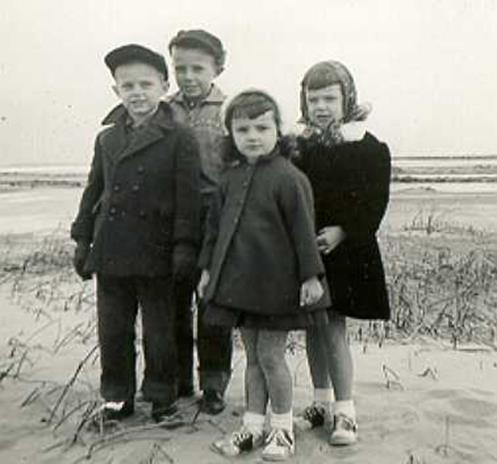
here, on the left, is a shot (circa late 1950s) of nephews Mike (b.1953) and
Jim (b.1952) and nieces Cathy (b.1955) and Mary (b.1954), before they started
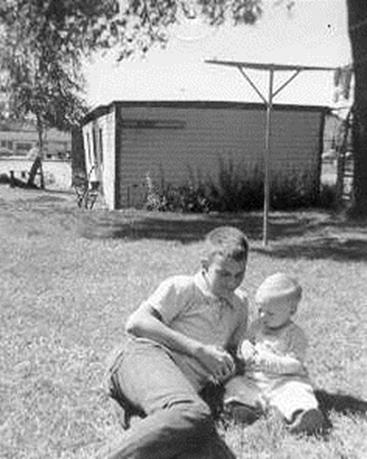
making such a "great" uncle out of me, and, on the right a shot of me
and Marilyn's firstborn, Jim (1954?), in front of the old boathouse, now torn
down, along with the great Chinese Elm in the background my swing was attached
to. :
|
|
|
In 1941 my
parents moved across the river from the town, and I spent the rest of my boyhood
living in a two-story red brick house on "River
Front," later inappropriately renamed "Brooklyn St,"
which was situated on the Portage River
just west of the Port Clinton Yacht Club
where the river bent north to follow its rerouting through dumped-in rock walls
to Lake Erie. The front of the house
looked out toward Lake Erie through "The Log Cabins," but the
property, with a dock and boathouse behind the house, was on the river and its
back looked out over the river toward the town. The ferryboat to the
islands used to park just across from us, as did the fishing fleet. “The Whistling Bridge” was to the right.

The way the front of the house looked then, with the
great Chinese elm in the back.
Dad landscaped this lot to the teeth.
Our house had a twin next door,
occupied by the people (the Hecklers) who owned "The
Log Cabins," a resort of about a dozen cabins which was just
across the street and between us and Lake Erie.
There was a period there when I grumblingly mowed
the lawns of the Log Cabins, the Hecklers, our lawn, and the lawn of
Mrs. Kelly, a ship captain's widow who had the only house on the river between
us and the Yacht Club. The Log Cabins
were eventually demolished and replaced by condos. The Yacht Club later bought both Mrs.
Kelley's house, which they tore down and replaced with a swimming pool, and our
house, where the keeper now lives on a property denuded of all the wonderful
landscaping my father so lovingly worked on.
See the evidence of the crime below, from the 1990s:

To continue
with the theme of the despoliation of a beautiful past (or the polluting of the
environmental gene pool, so to speak), Port Clinton
today is mostly condos and marinas and fast food joints from end to end, as its
summertime population at times doubles & triples its wintertime population
of around 7,000. During the new-fangled annual summer "Walleye Festival," I'm told, visitors
are thicker than June bugs (also called “Canadian soldiers” to identify their
origin). And they now have an annual "Walleye Drop" in the winter, during
which a huge papier-mâché fish is dropped into the river right across from my
old home. I'm told that David Letterman split his 1999 New Year's Eve show
between the ball-drop in Time's Square and the
Walleye Drop in Port Clinton, Ohoho.

Incidentally,
we didn't call them "walleyes" when I was a boy,
we called them "pickerel." And
nobody seems to remember how to cook them.
Squirt a whole pickerel with lemon juice, wrap it in bacon and an oiled
cooking bag, and bake at 350 degrees for at least an hour. It is to die for. This recipe was my father's, I am amazed to
realize. My housewife mother did all the cooking, except for the pickerel. An inveterate fisherman on weekends, my father always had a boat in his boathouse, a
32 foot sea-going Maine fisher being the most fondly remembered.

The
great boat, just off our dock (with the ferryboat to Put-in-Bay
in the background)
and samples of the
fish Mom & Dad caught on Sunday mornings,
while
I was at Sunday School and church representing them.
With a dock on the Portage River
about 75 feet off our back porch and a beach on Lake Erie about 100 yards off
our front porch through the Log Cabins, much of my youth was spent on or in
water and boats. Home or away, you'll
often still find me around water.
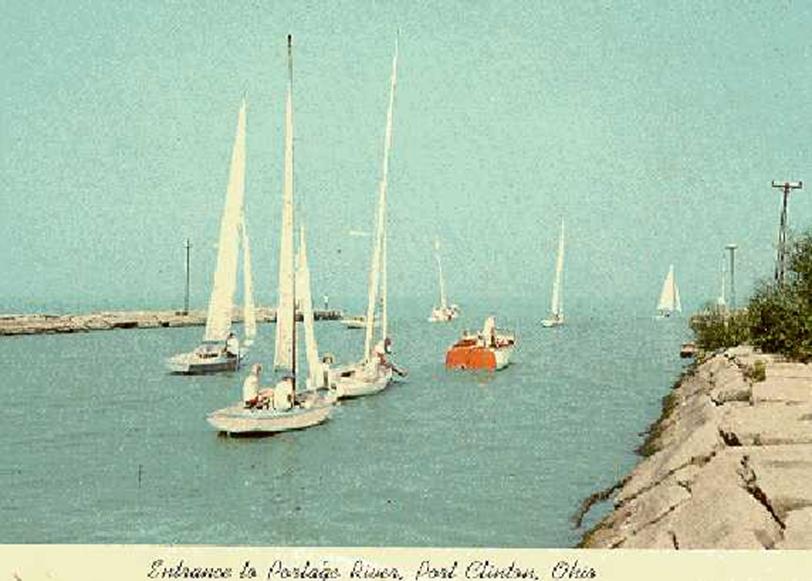
Around
the bend from the Yacht Club is Lake Erie.
To
the left of those rocks is my old swimming hole, so to speak.
However. However. Seldom were there
other children to play with in that neighborhood, which was mostly inhabited,
and then only in summers, by tourists and yacht club members, and so I grew up
lonely but imaginative, a tad bookish, and self-sufficient. Outdoorsy despite the bookishness, I spent many
wonderful hours engrossed in heroic pretense traversing the mystical trails of
the fantasy kingdom of the marshes around the western perimeter of the Yacht
Club (now filled in and occupied by tennis courts!) and the small fill-dirt
hills around the outside rim of the Yacht Club's lagoon. Grandpa Farr, who lived with us at the end of
his life, added immeasurably to that pretend kingdom by teaching me to read and
write well before other kids my age, a head start I never outgrew, as wonderful
book followed wonderful book, until I now live in a house of books, the kingdom
of the wise. That childhood was a foolproof recipe for becoming a
devoted reader and writer.
But then
there are the ways we try to contradict our
upraising. And find that it gets
us in the end, anyway.
Because my
parents had a tendency to keep their old homes rather than sell them, to which
they added a few other small homes later on, including the Farr homestead on
4th St. when my elderly grandparents moved in with us, they supplemented their
income by renting houses. My dad could do almost anything in the way of
plumbing, carpentry, electrical work, etc., and so they did all their own
remodeling and maintenance. There was always a project going somewhere. I did not participate much as a youth, being
above all that mere practicality (it's a wonder the vertigo didn't strike!),
but strangely in my adulthood I find myself with the same tendency to have a
construction or remodeling or landscaping project going somewhere, somehow. As a kid, I mostly ignored my father's
attempts to teach me plumbing, carpentry, etc., and thus I have had to learn
all that the hard way. To that end I still use some of my father's old tools. At last I must admit that, despite my best
efforts to avoid such a fate, I am my father's tool.
Another
example of the rebellion that turns on you
is in the attitudes toward work I've had
through my life. Today I share my father's workaholic nature, loathing time
wasted on the unproductive, but it was not so in my Port Clinton days. I lived
to play and hated every minute of the many hours I was forced to work, mostly
at hard jobs, as my parents insisted that childhood be a time for growing up
and preparing for adulthood. Where did that idea go? My own son has never had it occur to him!
I can't
remember at what age I began work, but it was quite young. I think I began at
about eight or nine with selling on downtown street corners "The
Port Clinton Herald and Republican." Dad had me bicycling around town with grocery
store flyers soon after, and I recall some bitter moments hopelessly pushing a
broom over a grocery store parking lot.
One exceptional, shining moment in my work life occurred when I won a
prize for selling the most light bulbs of anyone in the Cub Scouts, as I left
no door unknocked upon and a glorious career in sales
seemed to beckon. But mostly it was
drudgery. I sacked a million potatoes in
the back of my father's Kroger store, and then when he moved across the street
to Sorenson's Grocery I followed him
into my first serious, full-time jobs, working all summer six days a week and
then on Saturdays during the school year.
Fridays and Saturdays were from 8:00 to 8:00. I did every job there was to do, being
especially responsible for stacking shelves and setting up and striking the
produce stand outside each day, and I even clerked. This was back in the pre-self-serve days when
customers sidled up to a counter with a grocery list and the white-aproned
clerk got everything for you. In this I
learned to be polite to people and to banter with them, lessons seemingly
unavailable to today's youth.
My hardest
but most educational jobs came with physical maturity. In the summers of my 18th and 19th years I
worked at the canning factory at the
eastern end of 4th St., sometimes working double shifts when the trucks of
tomatoes lined up outside. Many 16 hour days were spent, say, pushing empty
catsup bottles onto a revolving disk that sent them onto the bottling line,
while other times I might be outside pouring tomatoes or other farm products
onto the conveyor belt that took the fruit past a row of frowsy ladies peeling
and inspecting before it was elevated to the cooking vats. On double-shift days
I would fall into bed at midnight and refuse to credit the alarm going off at
6:00 AM the next morning. I wanted to die, after a bit. And I can still
smell that sweet tomatoey aroma that hung over the
whole town during the height of the tomato canning.
But there
were compensations. For one thing, I encountered strange,
exotic people. The Mexicans living out back in shacks, who did most
of the grunt work, gave me my first cross-cultural experience with a minority
group. PCHS did not have a single African-American in its 1954 graduating class
of 96 students, let alone a Mexican, so it came as quite a shock to find myself
in daily contact with people of such dark complexion who barely spoke English.
But I became friends with a couple of them, learned much from them, and curse
myself to this day that I did not follow up that friendship outside the
factory.
The canning
factory was very hard, exhausting work, but little did I know that it was just
tuning me up for worse to come. For the
next five summers, when home from college, I worked at Celotex, one of those gypsum plants outside the
village of Gypsum, not far from the old Dietrich homestead. Called a "roustabout," I again did
every job imaginable, but mostly I worked on the loading docks with the old
pros, either slinging wallboard and lath into box cars or trucking 100 lb. bags
of plaster onto trucks. It was piece
work, and the old pro you were teamed up with took delight in making the
college kid keep up. It was
backbreaking, but teaming up with the likes of "Pappy," a gnarled man
in his 60s who looked exactly like "Popeye," complete with pipe, or
with mustachioed Wes, the only black man I've ever gotten to know with any
intimacy, was an education in itself. I learned all about "the
proletariat" there, which made me impervious to theoretical arguments
about them later on. "The
proletariat" just wanted to get the hell out of that factory, but stuck it
out so that their children could get out.
Meanwhile they had as much fun on the job as they could by telling bawdy
jokes and good-naturedly hazing the college kids, then drinking and carousing
after work. The sudden advent of TV got
some of them home a little earlier, I guess.
Another
thing I got from those work experiences was the relatively muscular and supple
body of an athlete. I haven't always
trained and sometimes weigh too much, but I've kept on with the games, despite
some killer injuries and knee operations.
All of the games, with touch football
and basketball being favored.
Below I'm doing my Babe Ruth warm-up routine at an annual faculty-staff
softball picnic, about 25 years ago.

Big Stick
But back to
the future. It was Port Clinton
that made me into the bookish jock I am
today. The great joys of my teen years
were books, girls, and sports. The
reading was indiscriminate and, clueless about the classics, I didn't read
anything really worthwhile, outside of possibly a few classic Science Fiction
and Fantasy novels, but at least I came out of this with the habit of reading
and the need for it (which culminated in a Ph.D. in English!). I was clueless about girls, too, but dated
the hell out of them and learned what joys they could bring to alleviate the
frustrations they imposed, we having arrived on the scene too early for
"the sexual revolution." And I
was especially clueless about sports, though I played them all with great zest
and some skill and lettered in varsity basketball. I always had a ball in
my hands, it seems. But why am I out of uniform on the top
right? Didn’t get the memo, I guess.
|
|
|
|
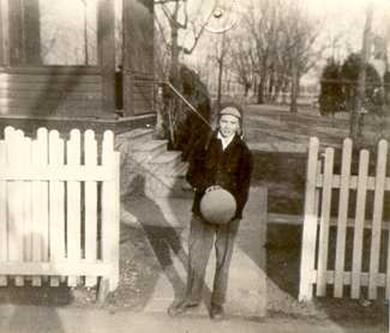
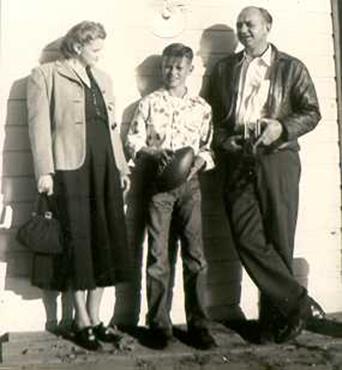

Clueless
about religion as well, despite or because of my 10 years of perfect Sunday School attendance, I tried to play sports like a good
Christian should. Which,
for example, lost me quite a few rebounds I should have had on the varsity
basketball team. When I got to college, all this changed, as I started
playing with guys who never worried about being "nice." Once I stopped worrying about being
"nice" (and who are the "Jocks for Christ" kidding?), I
became quite a decent athlete, in lots of different sports, and I went on to
play intramural, city or county league ball until I was near fifty. Then I passed on to tennis, racquetball, bicycling,
and exercise machines, although "The Grumps," the final name for my
group of bookish jocks (“philosopher kings,” we called ourselves), still
occasionally skip off to an over-60 basketball tournament, when injuries
allow. Originally, in graduate school, our teams were called "The El
Rancho Chargers," after the street we lived on in Tallahassee while
attending Florida State U. At a recent volleyball party in our back
yard, we had a reunion of the old
"Chargers" (when life was starting to get as blurry as this photo!):

And then came what I refer to as "The Uncoachables,"
masquerading as the Faculty Football Team (circa
1975).
I am the glue-fingered tight end in the middle of the
back row.

And the beat goes on, with new "ringers" all
the time
(players become “ringers”
when they’re a tad off of “legal”):

"The Grumps," as they were at last called,
couldn’t stop!
So volleyball was added late in their careers.

A selection of "Uncoachables"
or "Grumps" (take your pick),
take a break from backyard volleyball.
But they're always # 1:

I observe
now that this story has changed from emphasis on family to emphasis on
extra-family matters, as I follow the thread of my life into my teens,
twenties, and beyond, but an underlying note through it all is the effect Port Clinton had on me. This has turned out to be more a paean to
Port Clinton than it started out to be, or at least the Port Clinton of my
youth. I realize now how much that town
contributed to the building of my identity, and I'm probably also trying to
make up for the warped perception I had of it at the time I lived there, forty
years ago. Port Clinton was a wonderful
place to grow up, but I didn't know that at the time. I just knew that I was lonely and frustrated
in my ambitions there, and the town seemed backward and provincial. When I left for college, I went to Miami U.
in Oxford, Ohio, down near Cincinnati, partly because it was about as far away
as I could get and still be going to a state university. I considered it a reversal of sorts when,
upon graduating from Miami with a degree in Psychology in '58, I was forced to
attend nearby Bowling Green State University for my M.A. in English because I
could save money by commuting from home.
But then, after turning down a teaching assistantship at Ohio State U.,
it was on to an exotic Tallahassee and Florida State University for my Ph.D.,
the University of Delaware for my first full-time teaching position (5 years),
and then, after not being able to snag the job I wanted in California, back to
Florida at the University of South Florida in Tampa in 1968, where I continued
until retiring in 2004.
Living
northwest of Tampa in Odessa, I’ve enjoyed a quiet life in the country with my
wife Lori that afforded me time to do the writing and reading I so enjoy, with
lots of tennis and country walks or bicycling worked in. Here we are on
our neighborhood courts, no doubt on a Saturday morning:

But this
all changed in 2004 when I persuaded a group of other people interested in the Irish
playwright George Bernard Shaw to form a not-for-profit corporation called the
International Shaw Society (the ISS), of which I became founding President, and
much of my life since then has been devoted to running this corporation and
arranging conferences and symposiums, which has involved us in a great deal of
international travel. And that’s another
story (hinted at below), perhaps for another time.
To return
to the present narrative, the country quiet in Odessa has been and still is
occasionally interrupted by welcome visits or phone calls from friends and our three children.
Rick, from my
first marriage, after growing up in Tampa and graduating from Tampa Prep,
attended his father's alma mater, Miami U. of Ohio, and now lives in Cincinnati
doing Zot knows what but undoubtedly spending lots of time on the computer.

The essential Rick would probably not be just getting
out of a high school swim meet, as he is above, he'd probably be seated at a
computer eating a hot dog, but his father has taken liberties with his image
here, its being the essence of his father to do so. Following are images
he'd perhaps rather see, Rick as Peter Pan (1986?) and Rick as computer whiz
(2000):
|
|
|
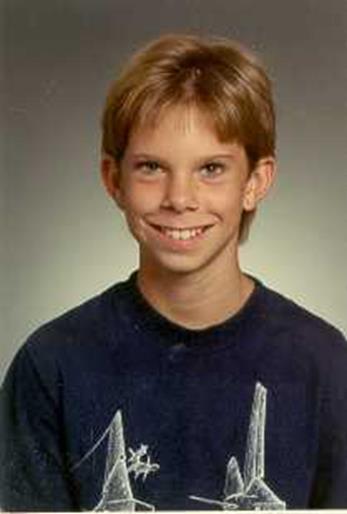
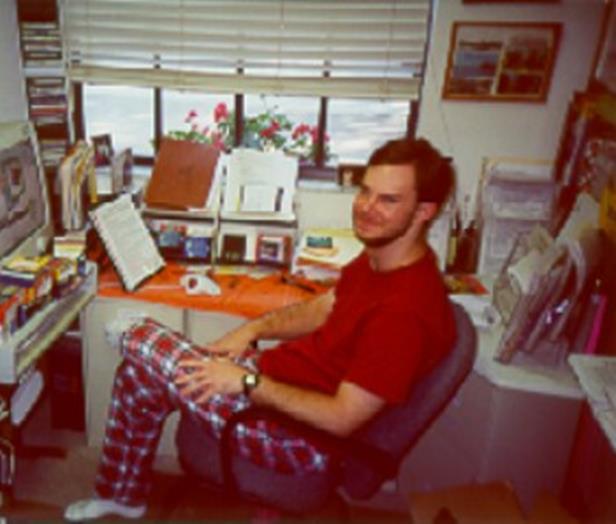
Today is a different and sadder
story for Rick, which will mostly have to wait for another time. For now, it’s enough to know that the mother (my
ex) he grew dependent upon has died and left him bewildered and floundering, an
unemployed man-child in an adult world he was never prepared for.
But back to the narration from the
past (with an occasional darkening of the tone to fit present circumstance):
From Lori's first marriage, we are
blessed with Travis and Lynn Marie Ruse. Well, to bring this up to date, WERE
blessed. Lynn Marie died on Aug. 31,
2013, at the age of 48, of a lung cancer that went undiagnosed way too long and
past the time when she could be saved from it.
She went through about 8 months of chemo hell. The rest of her story here, written before
she died, speaks of her in the present tense, as indeed she is in the mind and
heart of her mother, Lori, my second wife, and me, and her many friends and
relatives. Her memorial in New York was
spectacular for the size and scope of it, as hundreds crowded into the Judson
Memorial Church on Washington Square, known for its honoring of artists.
Lynn Marie is (all
present tenses are symbolic of the way we still feel about her) a dancer and
teacher of dance who operates her own dance troupe in New York—Freefall
LTD. But she makes most of her living
by teaching Yoga, having made several trips to India for special instruction.
The Essential Lynn Marie & Her Dance
Company--"Freefall"

Requiescat in Pace
Travis is a
photographer and Photo Manager for INC Magazine in New York, who won photo
blogger of the year for his wonderful visualizations of New York’s F train from
Brooklyn to Manhattan. In 2000 he teamed
up with sculptress/ physical therapist Cynthia Halpern
to produce our only grandchildren, Hope and Eva Ruse.
|
The Essential Travis,
lacking only a fishing pole or surfer
suit to make it more authentic. |
The Travis & Cynthia Dance Co., so
to speak. (Alas, divorce broke up
this pair; to be updated) |

|
With the sweet addition of Hope Charlotte Ruse, born
miraculously on 1/1/ 2000: |

|
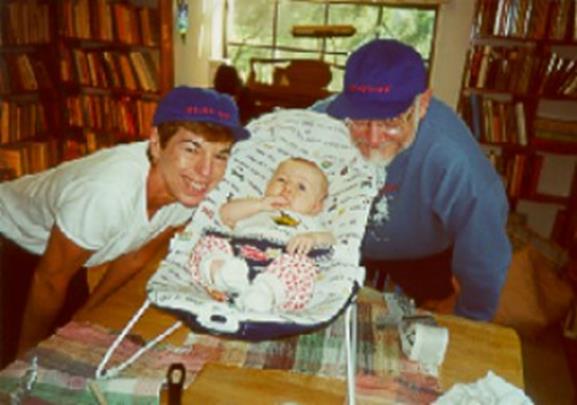
The Hopester shows grandpa around the hood. |
The Hopester is the one who should be
wearing the 01-01-00 cap. |
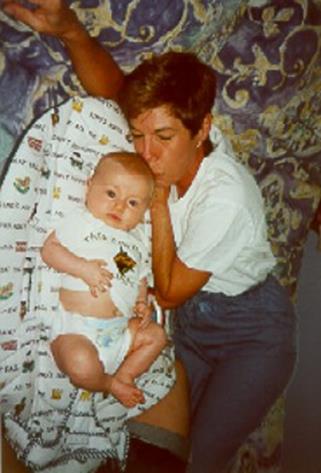
The Hopester gratifies grandma. |

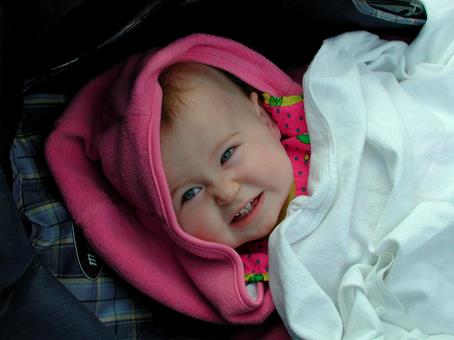
And then came Eva Winifred
Ruse in October of 2002.
|
|
Eva’s First Day at School |
Eva in 2012 |
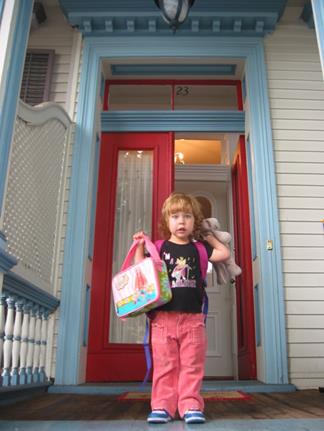

And now we have
a dynamic duo for granddaughters:
|
First
Day of School |
Eva & Hope hiding among the monkeys |
At a Yankees game, 2015 |
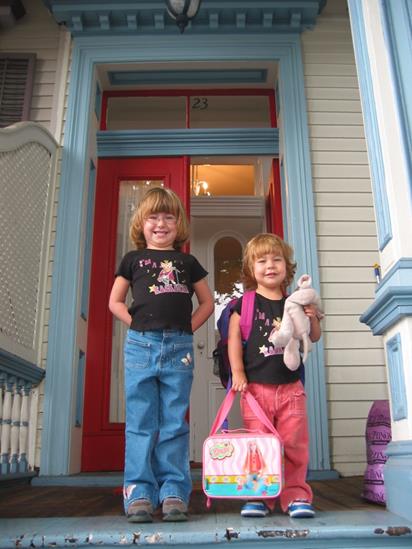
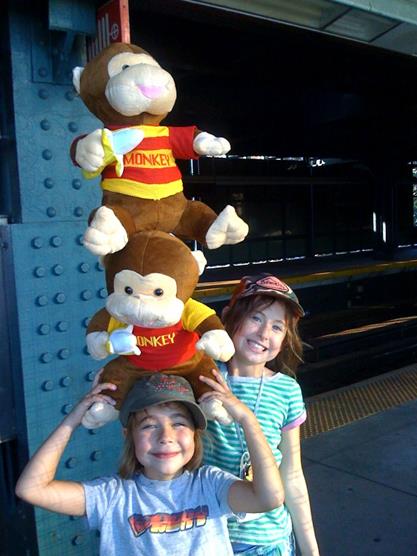
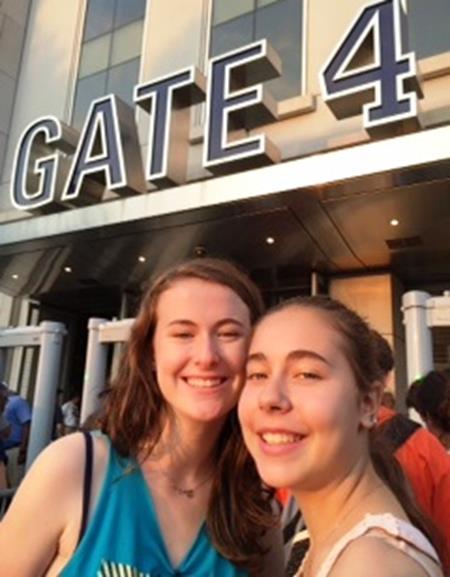
Travis,
Hope, Lynn Marie, Eva

All of
which added up about 20 years ago to a portrait of a late 20th Century family,
one of the characteristics of such a family being that the portrait had to
be constantly revised.
Here’s the
way it began, in about 1984:
A Very Post-Modern Family: The Ruse-Dietrichs

Above, Travis--Lynn Marie—Lori--Rick—Dick
Below, Lynn Marie—Travis—Rick—Lori--Dick

Below, A Revision Thereof, as Cynthia Joins In:

Cynthia—Travis--Lori--Lynn
Marie in Washington, D.C.
And there are more changes to come, for even this is not up to date,
as, for example:
The wedding of Travis and second wife Susan Glass in
Islamorada in the Keys, July, 2014.
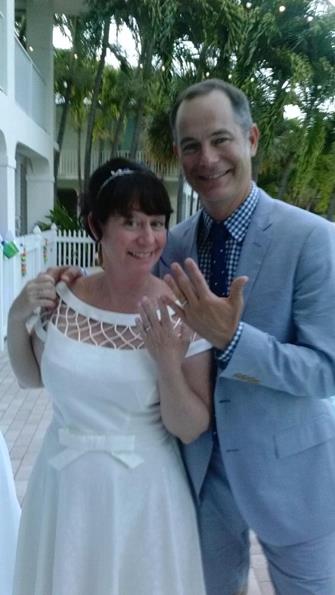
Travis
escorted to the beach altar by Eva and Hope

Lynn Marie's being a devoted
denizen of the East Village in New York and Travis & family being
Brooklynites gives us an excuse to visit one of our favorite dens of
iniquity--NYC. Not that my wife needs an
excuse. Lori loves to travel even more than I do and will pack her bags
at a moment's notice.
TOP

Here's Lori in Athens

Here's Lori in Venice
This could go on and on, but suffice it to say:
Here's Lori
ready for anywhere!!

Although strangely she claims that her favorite
restaurant
is our back porch, at sunset. Go figure!

Anyway, we've toured much of Europe
and the British Isles on an annual basis and make annual trips to the Shaw
Festival in Niagara-on-the-Lake, Ontario, a sample of which appears below:
|
Dick contemplates Lake Ontario from the back yard of what used to be our favorite
Niagara-on-the-Lake B&B, The Silvermist. Since torn down and replaced by an ugly ultr-modern building. It’s been a while since we’ve stayed in any
B&B. |
After marathon bike rides along the Niagara Parkway, we usually ended
up on Queenston Heights, half way to Niagara Falls, where Lori typically
refreshes herself with a tall beer. Update: we’re
too old and have too many joint replacements to allow biking anymore,
alas. But we still drive up
there. Just to the right of this Bistro
is where Niagara Falls began, about a million or so years ago. It’s cutting back so many inches every year
and will eventually end up in Lake Erie! |
|
|
|
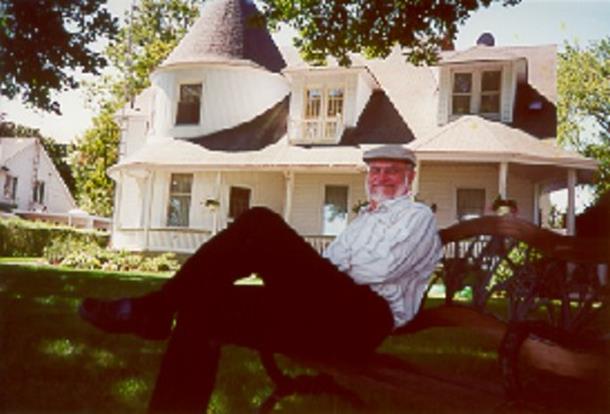
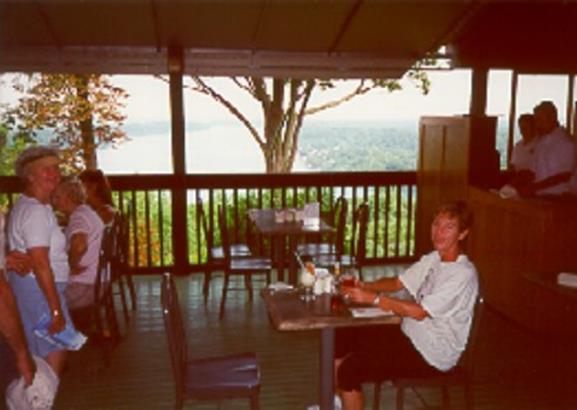
But our
travel dreams and longings take us most often back to our favorite haunt, the
Greek Isles, especially the mystical Santorini, an island that plays a crucial
part in my apocalyptic novel, The Final Solution,
now available at http://www.iuniverse.com/marketplace/bookstore/book_detail.asp?isbn=0595132731 and
soon, hopefully, available at www. barnesandnoble.com. A later novel, Earth
Angel, is also available at amazon.com.
Although
I've now gone on to the writing of fiction and plays in which I can indulge
such dreaming and longing, I can't leave this account of my life without at
least mentioning the many very undreamlike years of
work at and for the University of South Florida. While Lori thrived there as the gatekeeper to
seven presidents (four temporary), before retiring in 2002, I've ground out a relatively rewarding and
fulfilling academic career there as well, some of the aspects of
which--publications, courses, editorial work, curriculum vitae--can
be viewed by clicking on other links on the Ozymandias Home Page.
You'll also find there some hints as to how reading has shaped my
perspective on the world. Update: Little did I know when I wrote the
original of this auotbio that soon after finishing it
I would become in 2004 the elected Founding President of the International Shaw
Society, Inc., all of the founding documents having my name on them, and after
six years of that I would become the elected Treasurer and appointed Webmaster
of the Society, responsible for the ISS website to be found at www.shawsociety.org and the hundreds of
online pages linked to that, and so responsible for keeping the ISS membership
of all the Society’s doings and meetings.
This has become a full time job for the last 12 years. One of the pages I’ve uploaded is the story
of the ISS, at https://shawsociety.org/ISS-History-Mission.htm
.
So enough for now, until time allows for so
much-needed updating. Sum it up, narrator. Who is Richard Farr Dietrich?
It seems R.
F. D. is where he was raised, especially, but also the families that begat him
and he begat, the woman he loves, the friends enjoyed along the way, the things
he does, and the way he does them.
Applies to everybody, of course, but the narrator takes a narrow
view. If this ends not with an essence
of personality established, it's at least a hint at a work in progress. Or, at current age, regress. Other than that I can't say here, for only
fiction can do justice to the inner life.
Watch out for the Great American Novels to follow. I'll conclude now with a gallery
of guises that the old shape-shifter has assumed over the years, just to
remind me of who I've been:
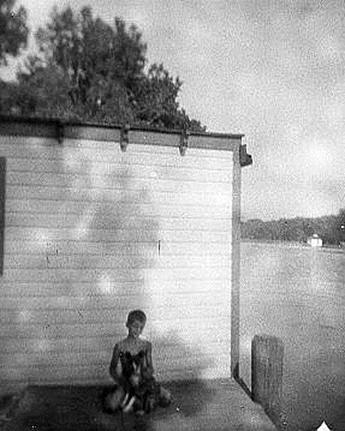
|
Spent many
hours with old "Butch," my brindle bull terrier, who didn't mind jumping into that river. |
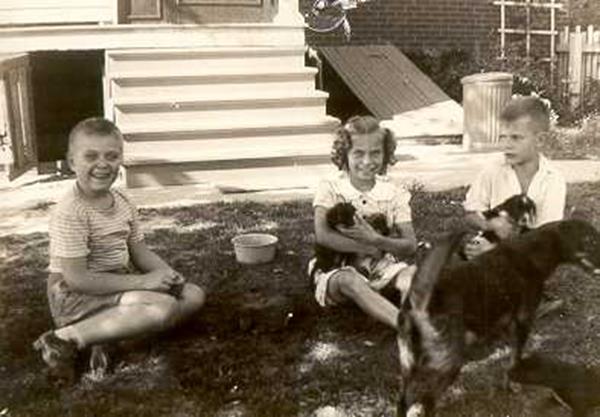
Here I am,
on the right, tossing Queenie's puppies around at the Heckler's next door,
with some relative of theirs and Judy, my first girl
friend, a daredevil. We played tackle
football, one on one, and she left me prostrate in the dust. |
|
|
|
|
|
|
|
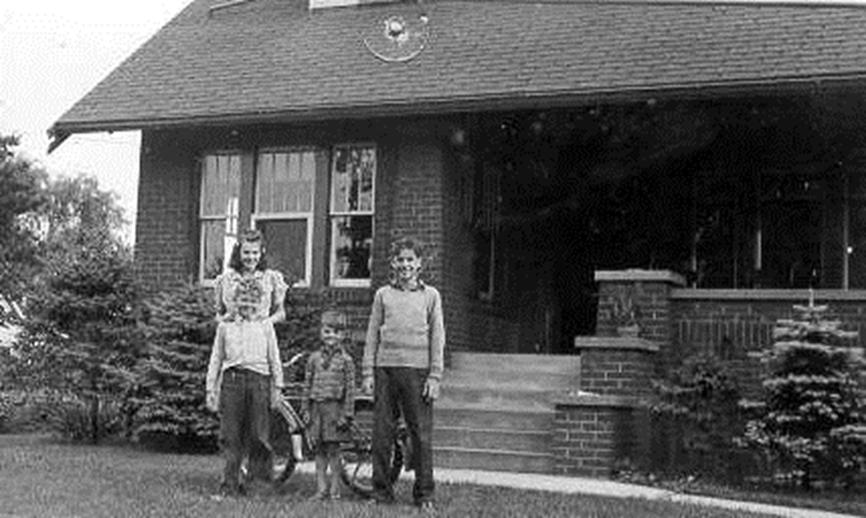
Above my sister has her
hands on cousin Kenny Dietrich, whilst I look small beside my cousin
Jim Dietrich. Uncle Fred's & Aunt Inzie's kids. Notice how that bike made it into
every picture in those days (1942?). |
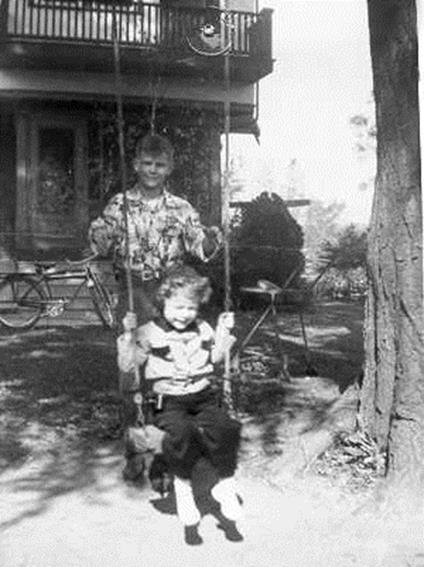
Many hours were spent flying high in
this swing, but here I'm keeping scaredy cat
Maryann Riggalls from Utica, NY, close to the
ground. |
|
|
|
|
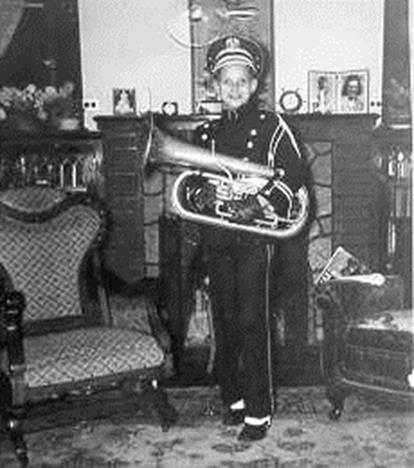
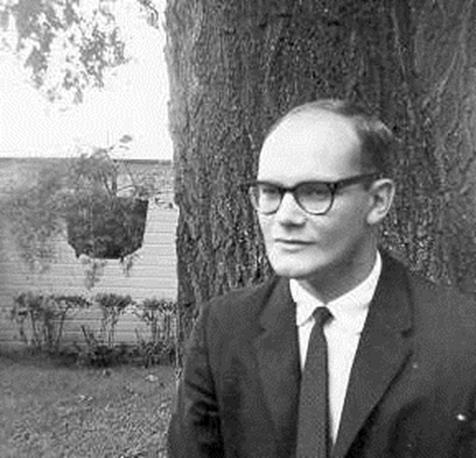
Seven years
in the high school band playing baritone is the only thing that kept me from
playing football and out of traction, which, later, just playing touch football
sent me into. |
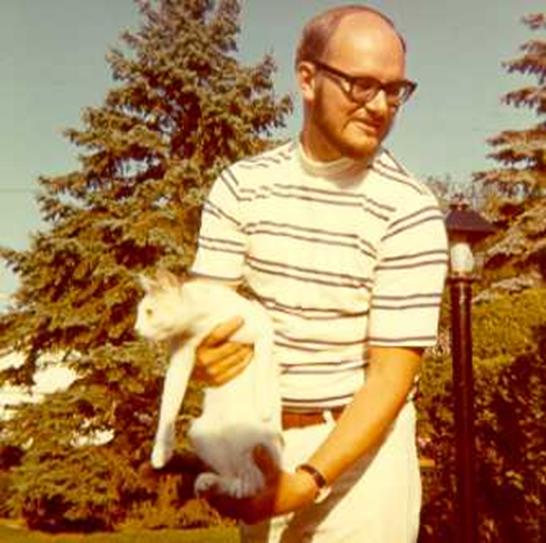
The guy
above I don't know at all. He went to
college and got some knowledge and lost his hair, poor schlump. |
|
|
|
|
This guy got married in 1968 (to first
wife Linn) and had his hands
full. |
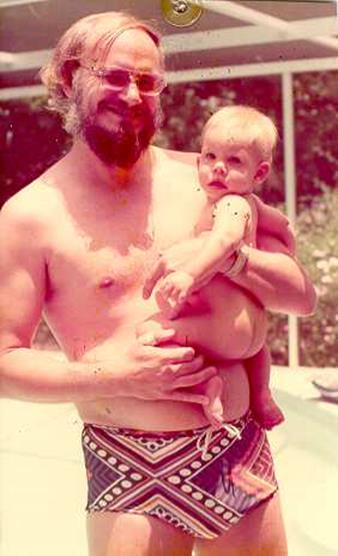
This guy
wore Speedos and made a swimmer out of Rick (years later on the Tampa Prep
swim team). The swimming pool was
courtesy of Holt, Rinehart, & Winston, whose royalties from several
textbooks built it. Not long after this, the pool and
everything else belonged to ex-wife. |
I’ve left the story above mostly as it was constructed
many years ago, but there have been many changes since, some very sad and even
gruesome, so if a major update ever takes place, it will be in a tone less
frisky and optimistic, accounted for by the fact that it’s being written by a
man who will soon turn 80 (January 16, 2016) and who has seen life take a few
turns into darker realms. And this
doesn’t even mention the world, which is more dark than light.
MORE TO COME?

----------------------------------------------------
Originated
in 2000?
Updated in
2001 and 20 June 2004
Last updated
1 December 2015